Navigating Challenges in OMS — Then and Now
Vivian Jui, DMD
12/8/2025
When Dr. Vivian Jui was in residency in the late 1980s, the field of oral and maxillofacial surgery looked very different than it does today. At the time, dental implants were primarily placed in edentulous patients and often only in operating rooms. Patient records were kept entirely on paper, and appointments were scheduled by hand in physical logbooks. Plating systems had just emerged, and wire fixation was still commonly used for fractures.
Orthognathic surgery planning was a manual process. “We used to trace X-rays by hand, create surgical templates, and take face bow records along with alginate impressions,” she recalls. “These were poured into plaster to form models, which we would then section manually to simulate jaw movements and plan surgeries.”
Today, as with other surgical specialties, technology has changed and advanced the way oral and maxillofacial surgery is practiced. OMS is a digitally driven specialty. Virtual surgical planning, custom plates, and widespread use of dental implants are standard. Medical records are computerized, allowing practitioners to access patient demographics, treatment histories, and even data on procedure profitability.
The financial landscape has undergone significant changes over the years. For many years, private practice was the practice model for oral surgeons; however, declining reimbursements and rising overhead have led to the onset of private equity firms and dental service organizations (DSOs) as major industry players.
Dr. Jui has witnessed — and adapted to — these sweeping changes. “When computers came online, we needed a workstation in every room. That was a huge expense,” she says. “So was switching to digital X-rays and downsizing CT scanners. My accountant nearly had a heart attack when I told him the cost.”
Although adapting to new technology isn’t always easy or cheap, Dr. Jui believes strongly in staying current. “We owe it to our patients to be up with the latest technology.” As with adapting to new research, she says, “You have to update your practice to align with the times.”
Fortunately for those interested in new tools, most come with robust training programs. For Dr. Jui, being part of a group practice has helped her stay up to date. “I’ve learned three or four different software platforms just from my associate,” she says. “It’s the younger generation teaching the older, and vice versa.”
Her advice for others navigating tech transitions? “You have to be willing to embrace it. It’s going to suck. It’s going to be hard. Just like learning piano. But you have to stay abreast in the field.”
Looking ahead, Dr. Jui sees new challenges emerging. “There’s always been a direct relationship between doctor and patient,” she explains. “But now, with the rise of corporate dentistry and new business models, another entity has inserted itself between the patient and the provider. I think that’s dangerous, and younger colleagues will have to be very careful navigating that.”
She’s also concerned about the financial pressures facing new OMS professionals. “They’re coming out of training with staggering debt,” she says. “They’re highly disciplined, high-achieving individuals, but that debt means they may be faced with a tough decision — having to put their money where their mouth is and stand firm on their principles, even when the financial consequences are steep.”
Although the decades have transformed OMS practice substantially, core values remain unchanged. Dr. Jui emphasizes that among both seasoned professionals and those new to the field, patient care continues to be the top priority. “Even when insurance makes one procedure more lucrative,” she says, “everyone I know does what’s best for the patient. That hasn’t changed. My associate and I always see eye-to-eye — it’s whatever the patient needs.”
She’s optimistic about the next generation of surgeons as a whole: “They really have their heads on straight,” she says.
For all the technological and structural changes, she believes the heart of the profession remains the same — a commitment to doing what’s best for those in their care.
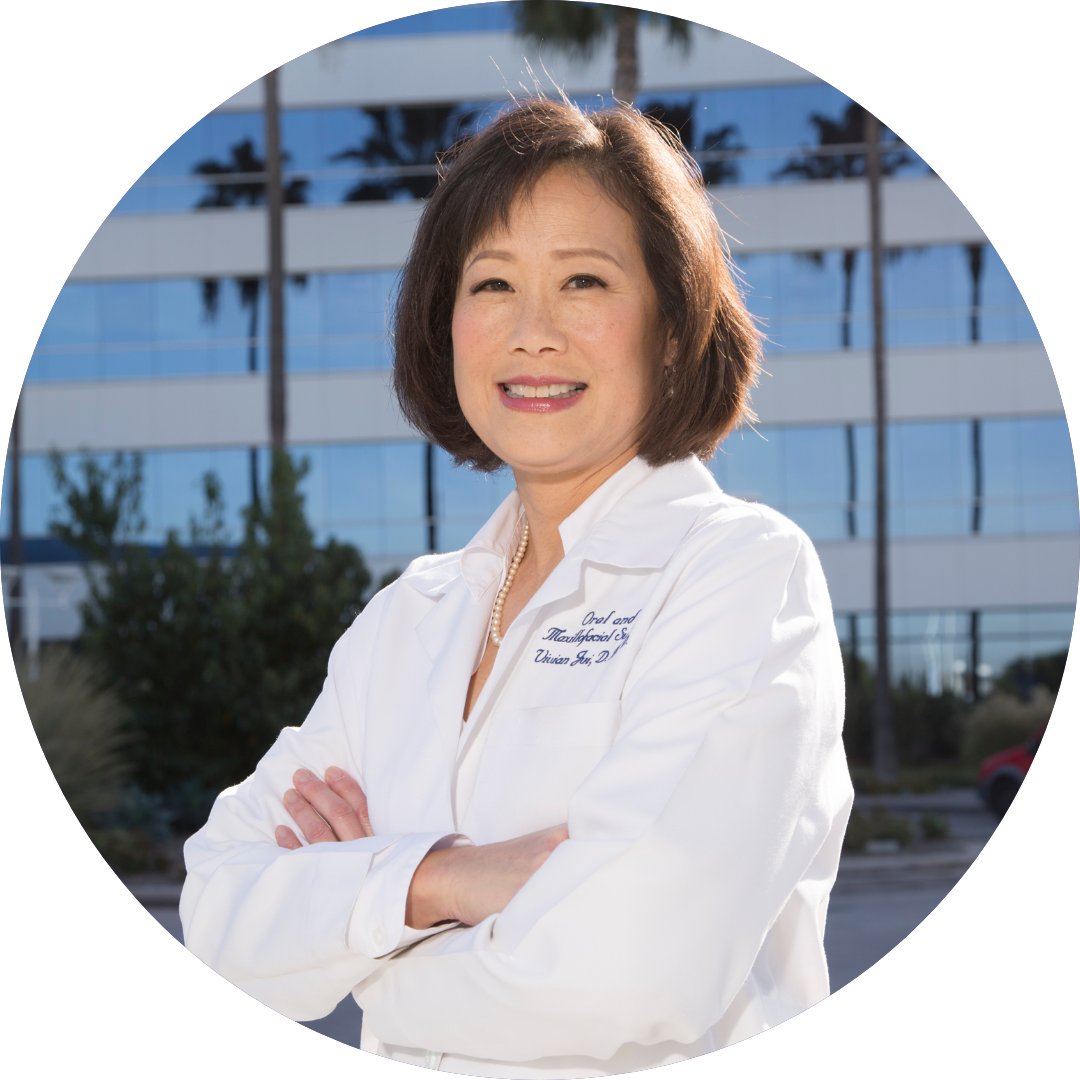
Vivian Jui, DMD
Vivian Jui, DMD, is a native of Michigan and received her Bachelor of Science degree at the University of Michigan. She attended Washington University School of Dental Medicine in St. Louis, Missouri, where she received her doctorate in dentistry. Her residency in oral and maxillofacial surgery was completed at the Nassau County Medical Center in East Meadow (now Nassau University Medical Center), New York, a State University of New York (SUNY) affiliate.
A resident of Southern California since 1990, she has practiced in the Irvine area since then. She entered solo practice in 1997 and remained so until 2016 when she merged her practice with Newport Oral Surgery. They are now a group practice with four oral surgeons and three offices. She has staff privileges at the Hoag Hospital Memorial Presbyterian. She has served as chairman of the departments of oral and maxillofacial surgery/Dentistry for both hospitals. She is president-elect of the California Association of Oral and Maxillofacial Surgeons and is Chairman of AAOMS’s Committee on Healthcare Policy, Coding and Reimbursement.
She is board certified by the American Board of Oral and Maxillofacial Surgery and is a Fellow in the American College of Oral and Maxillofacial Surgeons. Her memberships also include the American Association of Oral and Maxillofacial Surgeons, the California Association of Oral and Maxillofacial Surgeons, the American Dental Association and the California Dental Association. She has received her instructor's certification in BLS, ACLS and PALS.